UX case study · B2B application
Streamlining restocking decisions
Coolblue is a leading electronics retailer in the Netherlands and Belgium. Its buyers spent 30 to 45 minutes deciding whether to restock a single product. I designed the tool that cut that to 1 to 3 minutes.
30 – 45min
1 – 3min
+36%
Measured over 6 months

The team was one front-end developer (XAML for Windows), three back-end developers (.NET), a product owner and me, the UX designer. The tool ran only on Windows desktops, the hardware Coolblue supported.
I was the first UX designer to work on Coolblue's back-office systems, and I started this project before it had a product owner. That meant learning the business, its partners and the buyers' work from scratch, and hearing every stakeholder, including the CEO, whose influence was strong.
Problem
Why this project?
To restock one product, a buyer had to collect 17 data points, many of them hard to find in the old system. They worked the order out in their own spreadsheet, checked a shared wiki for the rules, and typed it back in. Each decision took 30 to 45 minutes.
So many products were restocked late, and many others were overstocked, which wasted warehouse space. Our business analysts saw slow restocking as a brake on revenue: every product that sold out was a sale lost to a competitor.
The people doing this were Coolblue's 19 buyers, each with a desktop PC, a mouse and a gamepad.
Deep diveWhy a shopper would notice


If you have bought something at Coolblue, you have walked this journey: choosing, ordering, delivery and after. Without good restocking it breaks in two places. The product is not in stock, or the warehouse cannot take more of it because it is full of something that sells more slowly.
Eight screens for one decision
I mapped every step a buyer took in the old system to decide whether to restock one product. Open any screen to see it full size.
Goals
Desired outcome
- Increase the frequency
- Ensure products are replenished more frequently.
- Reduce overstocking
- Minimise excess inventory to optimise warehouse space.
- Automate easy decisions
- Streamline the process for routine restocking tasks.
In brainstorms led by the product owner, we saw that many restocking decisions could be made by the system itself. So we built a learning system: an algorithm that restocks a product without asking the buyer at all. It learns from thousands of past decisions, from trends and sales, and from Coolblue's contracts with its suppliers.
Coolblue will always need chargers and cables, for example. The system knows how many, from whom and at what price, so no buyer has to decide that again.
That leaves buyers the decisions that need a person, like buying black, red and green barbecues in winter to sell next summer. That takes talks with manufacturers, price negotiation and signed deals: buyer work, not data entry.
It also takes the load off a buyer's memory. People move on, get sick and forget, and stock should not depend on that.
Process
How it was made
Working as a buyer
I started by interviewing and watching people across Coolblue, to learn its logistics, its promises to customers and how restocking really worked.
Then I role-played as a buyer and placed orders with the existing tools. Every decision came down to three questions.
-
Should I restock now?
The software flagged products running low and showed the buyer the data behind them.
-
If yes, how much should I restock?
The right amount depended on warehouse space and the supplier's stock, which were often hard to see. Some suppliers shared live stock levels and some did not, and contracts and delivery times differed per supplier.
-
Can I restock from my selected supplier?
This depends on the points above: contracts, delivery time, stock transparency.
The team also visited the warehouses twice, to see their limits and the tools on the floor.
Deep divePhotos from the warehouse visits


One decision at a time
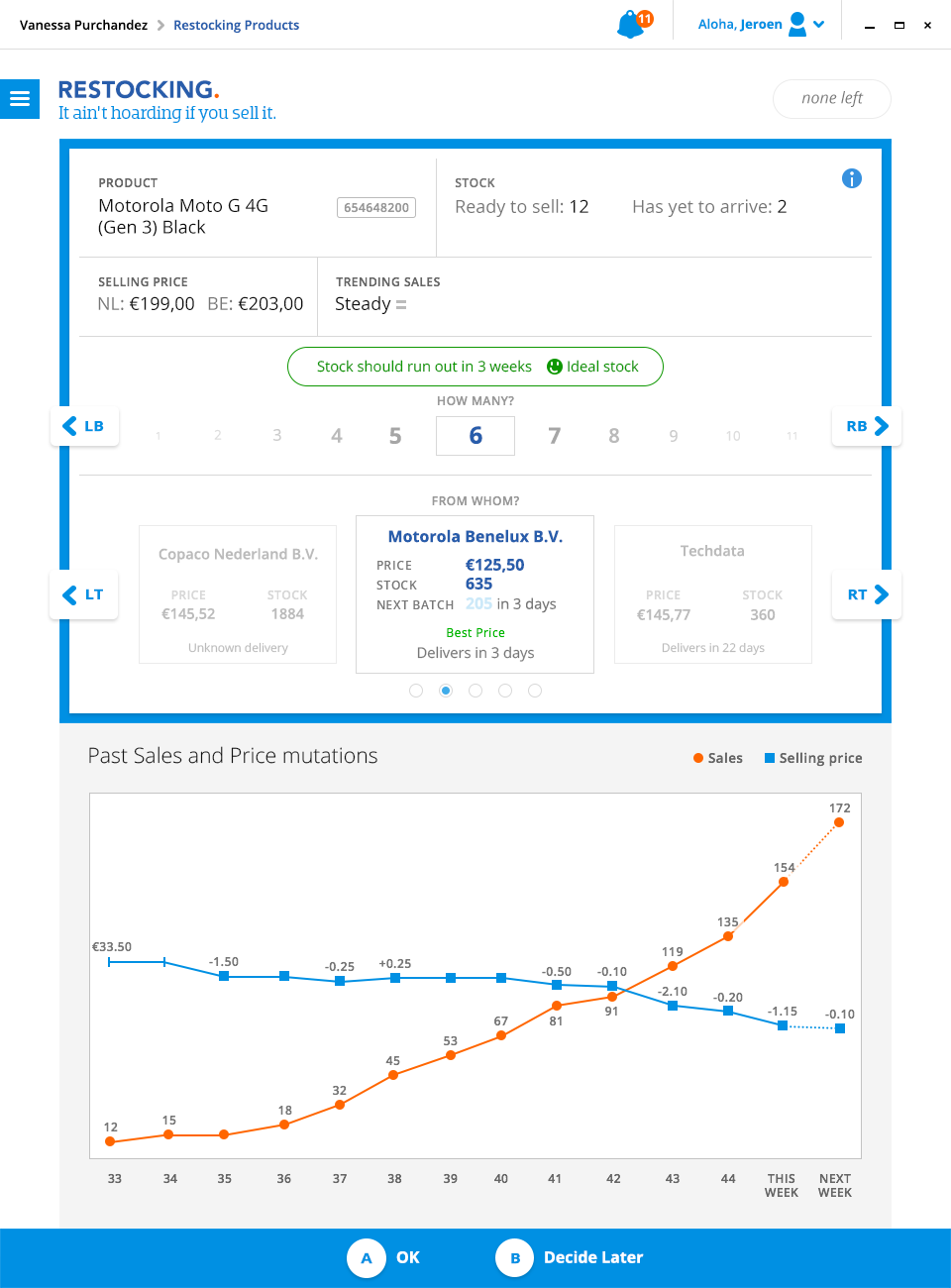
I drew the first wireframes. The CEO wanted a tool so simple you could run it with an Xbox gamepad. I took that as a figure of speech. It wasn't: gamepad support was a real requirement. I made sure the tool still worked well with a keyboard and mouse.
The system picked the products that needed restocking. For each one, the buyer answered the three questions: restock or not, how much, and from which supplier (one supplier at first). Then the next product appeared, until the day's list was done. The old process took eight screens; the new one took one.
Deep diveTwo more screens: the day's tasks and settings


Tested with buyers all the way
We tested at every stage. Buyers clicked through an InVision prototype from a shared link, and I wrote up their feedback for the team.
After launch, I ran a feedback session after every sprint, and in the end invited buyers into our team room to use the live tool and question the developers directly. Sprint demos for buyers and stakeholders kept everyone in step on new features and on our targets.
Conclusion
Results
Per restocking decision, down from 30 to 45 minutes (self-reported).
Saved by each buyer, every day. Restocking used to take about an hour of a buyer's day; now it took a few minutes, and they got on with the rest of their work.
Product availability across the whole portfolio, over six months, automated orders included.
A quarter of all restocking decisions, made by the learning system with no buyer involved. Buyers spent that time on suppliers and long-term planning.
Showing one product at a time also changed how buyers ordered. They made more, smaller decisions instead of large orders that overstock the warehouse, and that is what raised availability.
Deep diveHow we measured
We had no A/B test. We judged the tool on Coolblue's own business figures. With only 19 buyers, I could interview every one of them, so the research was qualitative and covered everyone.
Decision times are what buyers told us. Overstocking was a goal, but never at the cost of products selling out. We did not measure by how much it fell: logistics staff in the warehouse reported that it did. What we did measure is that availability went up.
This is the product as I left it in 2016. It has changed a lot since: it was built as a Windows desktop application, and Coolblue has since moved to a web app.